Non-Surgical Facelift Options in McKinney: Fotona 4D vs. Ultherapy vs. FaceTite
Non-Surgical Facelift Options in McKinney: Comparing Fotona 4D, Ultherapy, and FaceTite for Skin Tightening Treatments

When patients ask me about non-surgical facelifts, they usually want clear information on what each option does and how it fits their life. In my experience treating patients in McKinney, Fotona 4D, Ultherapy, and FaceTite are commonly considered because they can improve tone and tighten skin without major surgery. This article compares how each technology works, the likely benefits, and practical considerations like recovery and cost so you can make an informed choice about your aesthetic goals.
Choosing between these options often comes down to a few practical factors: how much laxity you have, whether you prioritize immediate contouring or gradual regeneration, how much downtime you can accept, and whether you prefer fully non-invasive treatments or are comfortable with minimally invasive techniques. I discuss each of those considerations below and offer practical guidance on matching the right approach to common clinical scenarios.
Key Takeaways
- Fotona 4D, Ultherapy, and FaceTite are popular non-surgical facelift options in McKinney.
- Fotona 4D uses laser technology to stimulate collagen and improve skin texture.
- Ultherapy employs ultrasound to lift and tighten skin, suitable for face and neck areas.
- FaceTite uses radiofrequency energy for immediate skin tightening with minimal downtime.
- Fotona 4D offers customizable treatments targeting specific skin concerns and areas.
- Ultherapy results develop gradually, with improvements continuing over several months.
- FaceTite provides immediate results, ideal for those seeking quick skin contouring.
- Costs vary based on treatment type and provider; consultations are recommended.
- Integrative medicine enhances non-surgical facelift outcomes by supporting overall skin health.
What Are the Key Non-Invasive Facelift Treatments Available in McKinney?
In my experience treating patients in McKinney, several effective non-surgical facelift options are available. The three primary choices are listed below.
- Fotona 4D : A laser treatment that rejuvenates the skin by stimulating collagen production and improving skin texture.
- Ultherapy : Utilizes ultrasound technology to lift and tighten the skin gradually, making it suitable for various areas of the face and neck.
- FaceTite : A minimally invasive procedure that employs radiofrequency energy to provide immediate results with minimal downtime.
Each option has different strengths. Understanding those differences helps match the right treatment to your goals and lifestyle.
Good candidates for non-surgical facelifts generally want improvement rather than complete surgical correction. During a consultation we evaluate skin quality, bone structure, fat distribution, and your treatment goals. That allows us to recommend a plan that may include one primary modality or a combination staged over time.
Fotona 4D
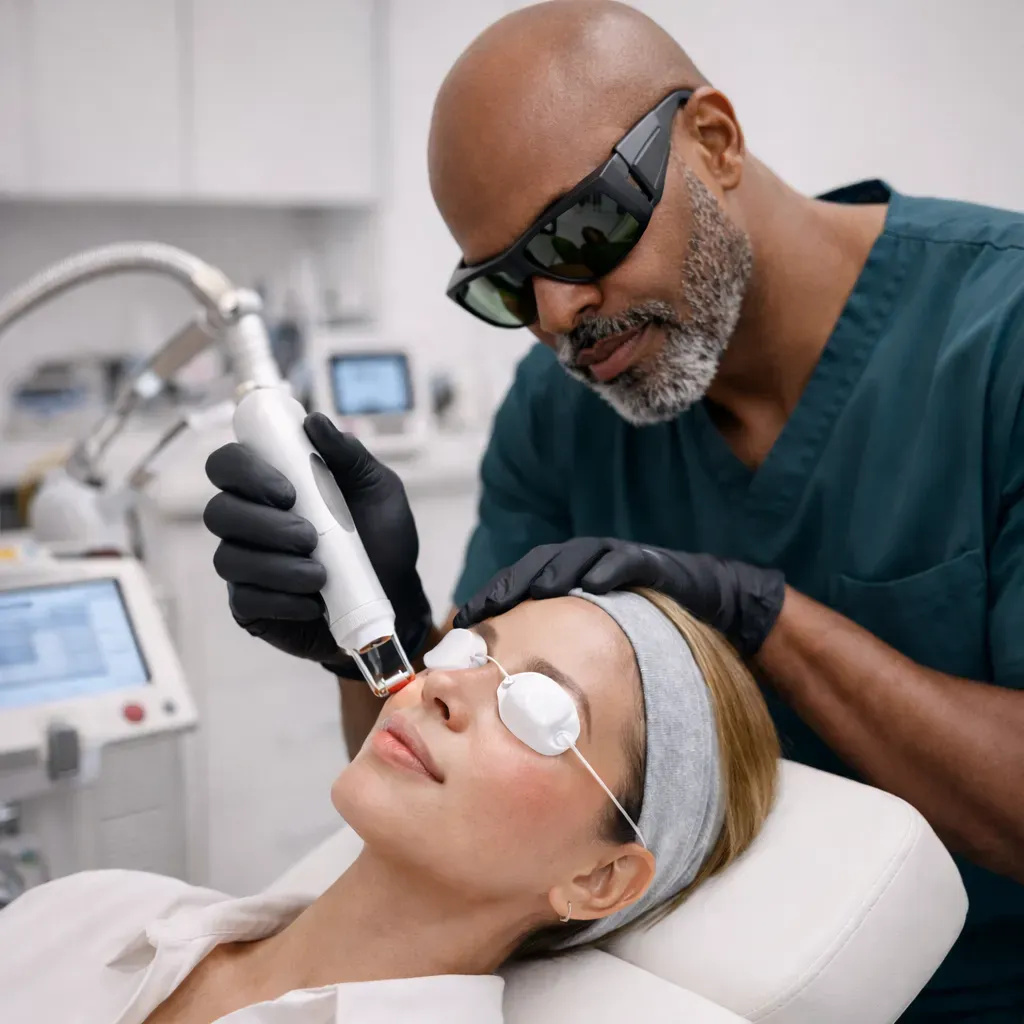
Fotona 4D delivers controlled laser energy to stimulate your body's natural collagen production. That improves elasticity and surface texture. Downtime is usually minimal, so it fits into a busy schedule. The treatment reduces fine lines and can be customized to target specific areas for a tailored result.
In practice, Fotona 4D is often used to address surface texture, fine wrinkles, and mild to moderate laxity. We can tailor the sequence and energy settings based on skin type and concerns, and combine the delivery modes in a single session for layered benefit. Many patients appreciate the balance of efficacy and rapid recovery, making it a useful choice when texture and tone are the main priorities.
When discussing Fotona with patients, I review realistic expectations: laser therapy encourages gradual remodeling, and visible improvements evolve over weeks as collagen matures. Post-treatment skincare, sun protection, and occasional maintenance sessions help preserve results and maintain skin quality over the long term.
Ultherapy

Ultherapy uses focused ultrasound to stimulate collagen deep in the skin. Results appear gradually as new collagen forms over several months. It's useful for lifting the brow, neck, and décolletage. Because it is non-invasive, most patients return to normal activities right away.
Clinically, Ultherapy is valued for its ability to target deeper structural layers that support the skin. This makes it a good option when the primary concern is mild to moderate sagging rather than surface texture. Patients often notice progressive tightening over a period of months, and we plan follow-up visits to chart improvement and determine whether adjunctive treatments could enhance outcomes.
During consultation I explain what sensations to expect and how to plan the treatment into your schedule. For many people the lasting, natural-looking lift is the most meaningful outcome, particularly when combined with surface rejuvenation like lasers or topical regimens that address tone and pigmentation.
FaceTite
FaceTite is a minimally invasive radiofrequency procedure that tightens and contours the skin. Many patients notice improved tightness soon after the procedure. It is performed under local anesthesia and can be a good option for those seeking jawline definition or reduced skin laxity without a surgical facelift.
FaceTite's minimally invasive approach allows targeted heating of tissue to contract and remodel collagen while preserving the overlying skin. Because it involves small access points and local anesthetic, recovery is generally faster than surgical options, though some temporary swelling or bruising is common. We discuss expectations for the immediate postoperative period and the timetable for seeing the final contour.
In selecting FaceTite, we consider the specific contour goals and whether addressing underlying fat, skin laxity, or both is necessary. In some cases combining a minimally invasive radiofrequency approach with surface treatments or injectables can create balanced, natural results with less overall downtime than surgery.
Clinical literature supports the effectiveness of minimally invasive radiofrequency devices like FaceTite for treating skin laxity and achieving meaningful clinical results.
Minimally Invasive RF for Skin Laxity & Rejuvenation
The literature indicates that minimally invasive radiofrequency devices can produce significant clinical improvements for indications such as skin laxity and scarring. These treatments are generally safe and often require little to no downtime.
Minimally invasive radiofrequency devices, 2016
Overview of Fotona 4D Laser Skin Rejuvenation Technology
Fotona 4D uses a multi-phase approach to treat different skin layers. The initial phase addresses the superficial layer to improve texture and fine lines. Later phases penetrate deeper to stimulate collagen and improve elasticity. This layered strategy supports both visible improvement and longer-term skin health.
The multi-phase design lets us customize each session to the patient's priorities: smoother texture and refined pores at the surface, with deeper stimulation to support structural firmness. This flexibility is part of why Fotona remains a core option when the aesthetic plan calls for both immediate and progressive improvements.
Introduction to Ultherapy Ultrasound Skin Tightening Procedure
Ultherapy delivers focused ultrasound energy at specific depths to stimulate collagen formation. It is FDA-cleared and has a safety profile supported by clinical use. By targeting precise layers, Ultherapy promotes a natural lifting and tightening effect without surgery.
We discuss patient-specific goals before treatment and select the depth and coverage that best address visible sagging. Because results depend on biological remodeling, patience and realistic expectations are important; the gradual improvement is often preferred by patients seeking a subtle, natural enhancement rather than a dramatic surgical change.
Research has examined Ultherapy's ability to tighten facial skin, particularly in areas prone to sagging.
Ultherapy Efficacy for Facial Skin Tightening
This study investigated Ultherapy for facial skin tightening, evaluating its efficacy and safety for mid-face and lower-face sagging.
Use of micro-focused ultrasound for skin tightening of mid and lower face, D Shome, 2019
How Does Fotona 4D Laser Treatment Work for Facial Rejuvenation?
Fotona 4D delivers precise laser pulses that trigger your body's healing response and encourage collagen production. That leads to improved texture and elasticity. The system is adjustable for different skin types and concerns, and most patients report only mild discomfort during treatment.
I walk patients through expected sensations, typical post-care, and the sequence for a course of treatments. Protecting the skin from sun exposure and following a gentle skincare routine after sessions helps maximize the regenerative effect and reduce the chance of irritation.
Clinical studies further support Fotona 4D systems for improving skin laxity and reducing wrinkles through collagen regeneration.
Fotona 4D Laser for Skin Laxity & Wrinkle Reduction
Laser systems like Fotona primarily work by inducing controlled collagen denaturation, contraction, and subsequent regeneration to improve skin laxity and wrinkles.
Three‐Dimensional Imaging of Dynamic Changes After Nd: YAG/Er: YAG Laser Skin Tightening: A Prospective Study, 2026
Expected Benefits and Recovery Timeline for Fotona 4D
Benefits of Fotona 4D include smoother texture, reduced fine lines, and more even tone. Downtime is minimal for most patients. You may notice early changes within a few days, with optimal results developing over several weeks as collagen remodels. Post-treatment skincare helps preserve and enhance outcomes.
In counseling patients I emphasize the practical timeline: initial improvements in texture and tone are common, while full tightening and structural changes evolve more slowly. Because individual healing differs, we set follow-up appointments to assess progress and discuss maintenance options that align with lifestyle and goals.
What Should Patients Know About Ultherapy for Skin Tightening?
Patients should know Ultherapy produces gradual improvement over months as collagen forms. It works across multiple skin types and treatment areas. Some people feel mild discomfort during the procedure and may have temporary tenderness afterward. Clear expectations about timeline and recovery improve satisfaction.
During a consultation I review realistic outcomes and whether adjunctive treatments — for example, surface lasers or targeted injectables — might complement the lift Ultherapy provides. Planning treatment sequences thoughtfully often leads to more balanced, durable outcomes.
How Does FaceTite Radiofrequency Treatment Compare for Non-Surgical Facelifts?
FaceTite offers more immediate contouring compared with fully non-invasive options. Because it uses local anesthesia and a minimally invasive approach, recovery is typically quicker than surgical facelifts. Many patients see meaningful improvement in tightness and facial contour soon after the procedure.
I review post-procedure care in detail so patients know how to manage swelling and activity during recovery. Follow-up visits let us monitor healing and make any recommended adjustments to ensure the contouring we achieved integrates well with the surrounding anatomy.
What Are the Differences Between Fotona 4D, Ultherapy, and FaceTite?
Fotona 4D uses laser energy to improve surface texture and stimulate collagen. Ultherapy uses focused ultrasound to achieve lifting and tightening at deeper layers. FaceTite applies radiofrequency energy with a minimally invasive technique to contour and tighten. The best choice depends on your goals, skin type, and tolerance for downtime.
In practical terms, choose Fotona when texture and tone are primary concerns, Ultherapy when deeper lifting is needed without incisions, and FaceTite when localized contouring and more immediate tightening are desired. Many patients benefit from a staged plan that combines modalities to address both structure and surface quality.
Typical Results and Duration of Effectiveness
Results vary by individual and treatment area. Fotona 4D often produces improvements that remain noticeable for months as collagen matures. Ultherapy can continue improving for up to a year. FaceTite gives immediate contouring, with effects that may last several months to a year depending on maintenance and skincare.
To preserve results, I encourage patients to adopt maintenance strategies including periodic clinical reviews, protective skincare habits, and targeted touch-up treatments when appropriate. A tailored maintenance plan helps prolong the benefits of any non-surgical approach.
What Are the Typical Costs and Consultation Process for Non-Surgical Facelifts in McKinney?
Costs depend on the procedure, extent of treatment, and provider. I recommend a consultation to assess your needs and provide a personalized quote. During the visit we review goals, skin condition, and the most appropriate options for you.
During a consultation we also review medical history, prior procedures, and realistic expectations. I encourage patients to bring recent photographs and a list of current skin care products or medications so we can tailor recommendations. Understanding scope of treatment and follow-up care is an important part of an informed decision.
How to Book a Personalized Consultation with Dr. Tobore Kokoricha MD
To book a personalized consultation with me, call (469) 606-2008. In the appointment we'll discuss your goals, review treatment options, and outline a plan tailored to your needs. — Dr. Tobore Kokoricha, MD, McKinney, TX
At the consultation we cover the practical checklist: discuss current health concerns, review photos and treatment options, outline expected recovery, and schedule any necessary pre-treatment steps. This conversation helps create a customized, safe plan that aligns with your priorities.
Patient Testimonials and Case Studies on Fotona 4D, Ultherapy, and FaceTite
Patient testimonials and case studies commonly report measurable improvements in texture and firmness. Before-and-after examples help illustrate realistic outcomes and the range of results you can expect.
When reviewing testimonials, I advise patients to look for clear, well-lit documentation and to ask about the timeline between pictures. Case studies that include clinical notes on the treatment sequence and follow-up create a more reliable context for comparison than standalone images.
Before-and-After Results and Visual Evidence of Skin Tightening
Before-and-after photos can show meaningful improvement in skin laxity and overall appearance. I review these examples with patients to set realistic expectations and to explain what is achievable with each treatment.
Visual evidence is most useful when paired with a description of the treatment plan, number of sessions, and post-treatment care. During consultations we examine cases that match a patient's skin type and concerns so expectations are grounded in comparable experiences.
How Does Integrative Medicine Enhance Non-Surgical Facelift Outcomes?
Integrative medicine supports healing and longevity of results by addressing nutrition, stress, sleep, and lifestyle factors that affect skin health. When we optimize overall health, patients often report better satisfaction with aesthetic outcomes.
In my practice, integrative strategies are practical additions: focusing on nutrition that supports skin repair, improving sleep quality, managing stress, and encouraging hydration and sun protection. These measures do not replace procedural care but can magnify and sustain procedural benefits over time.
Supporting Long-Term Skin Health and Rejuvenation in McKinney
Long-term skin health requires ongoing attention: sun protection, hydration, consistent skincare, and regular follow-ups. Prioritizing these habits helps maintain the benefits of non-surgical treatments and supports overall well-being.
Practical daily steps—broad-spectrum UV protection, gentle cleansing, targeted topical therapies, and avoiding behaviors that accelerate aging—are the foundation of maintenance. Regular check-ins allow us to refresh the treatment plan and address evolving needs as skin changes over time.
To explore options for enhancing your well-being, consider the benefits of integrative medicine at Oasis Clinic & Spa.
If you are interested in exploring laser skin treatments , Oasis Clinic & Spa offers a range of advanced options.
Frequently Asked Questions
What is the recovery time for non-surgical facelift treatments?
Recovery varies by procedure. Fotona 4D usually involves minimal downtime and quick return to activities. Ultherapy allows immediate return to routine, though some may have short-term swelling or redness. FaceTite typically has a faster recovery than surgical options, with many patients noting early improvement and limited discomfort. Follow post-care instructions to support healing.
Practical recovery tips include planning lighter activities for a few days after most procedures, using cold compresses for comfort if recommended, and following any topical or oral instructions provided at the visit. Clear aftercare reduces the risk of complications and speeds recovery.
Are there any side effects associated with these treatments?
These treatments are generally safe but can cause temporary effects. Fotona 4D may cause short-term redness or swelling. Ultherapy can be uncomfortable during treatment and produce transient tenderness. FaceTite, being minimally invasive, may lead to modest bruising or swelling. Discuss risks and what to expect during your consultation.
We screen for contraindications and review your medical history to minimize risk. If you have specific health concerns or previous procedures, bring that information to your consultation so we can tailor care appropriately and plan a safe, effective approach.
How long do the results of these treatments last?
Longevity varies. Fotona 4D improvements can last for several months as collagen remodels. Ultherapy results may continue to develop for up to a year. FaceTite offers immediate contouring with effects that can last months to a year, depending on maintenance, skincare, and lifestyle factors. Regular follow-up helps preserve results.
Maintenance strategies are individualized; during follow-up visits we evaluate whether touch-up sessions, topical regimens, or complementary treatments would extend the benefits in a way that fits your schedule and goals.
Can these treatments be combined for better results?
Yes. A tailored combination can improve overall outcomes—for example, using Ultherapy for lift and Fotona for texture. Combining modalities addresses different layers and concerns. Discuss a personalized plan with a qualified provider to ensure safety and effectiveness.
Combining treatments is often staged so each modality contributes at the right time: surface treatments can refine texture after deeper lifting, and minimally invasive contouring can be selected when structural support is needed. Thoughtful sequencing increases the likelihood of balanced, durable results.
What should I consider before choosing a treatment?
Consider your skin type, primary concerns, desired timeline for results, and tolerance for downtime. Also review the practitioner's experience and your medical history. A clear discussion during consultation helps select the safest, most appropriate approach.
Asking a few targeted questions during your visit—about expected results, number of treatments typically recommended, and recovery logistics—helps you compare options and choose a path that aligns with your priorities.
How can I maintain the results of my treatment?
Maintain results with sun protection, hydration, and a consistent skincare routine tailored to your skin. Regular follow-ups let us monitor progress and adjust treatments. Healthy habits—balanced diet, sleep, and stress management—also support long-term skin health.
I also recommend scheduling periodic review visits so we can refresh the plan as needed and address early changes before they progress. This proactive approach often reduces the need for more intensive interventions later.
Conclusion
Choosing the Right Non-Surgical Facelift in McKinney
Every patient I see has a different starting point — different skin quality, different goals, and a different tolerance for downtime. That's exactly why I don't recommend one technology over another before a proper evaluation. Fotona 4D, Ultherapy, and FaceTite are all effective when matched to the right candidate.
What I can tell you is this: the best non-surgical facelift isn't the most aggressive one — it's the one designed around your skin, your lifestyle, and your realistic expectations.
If you're in McKinney, Frisco, Allen, or the greater North Dallas area and want a physician-guided conversation about which approach makes sense for you, I'd welcome the opportunity to meet you. Schedule a consultation at Oasis Medical Clinic & Spa and we'll start with an honest assessment — no pressure, no one-size-fits-all protocols.
— Dr. Tobore Kokoricha, MD, Board-Certified Internist & Functional Medicine Specialist, Oasis Medical Clinic & Spa, McKinney, TX
